Bank of England Holds Base Interest Rate at 3.75%
Thursday 5 February, 2026
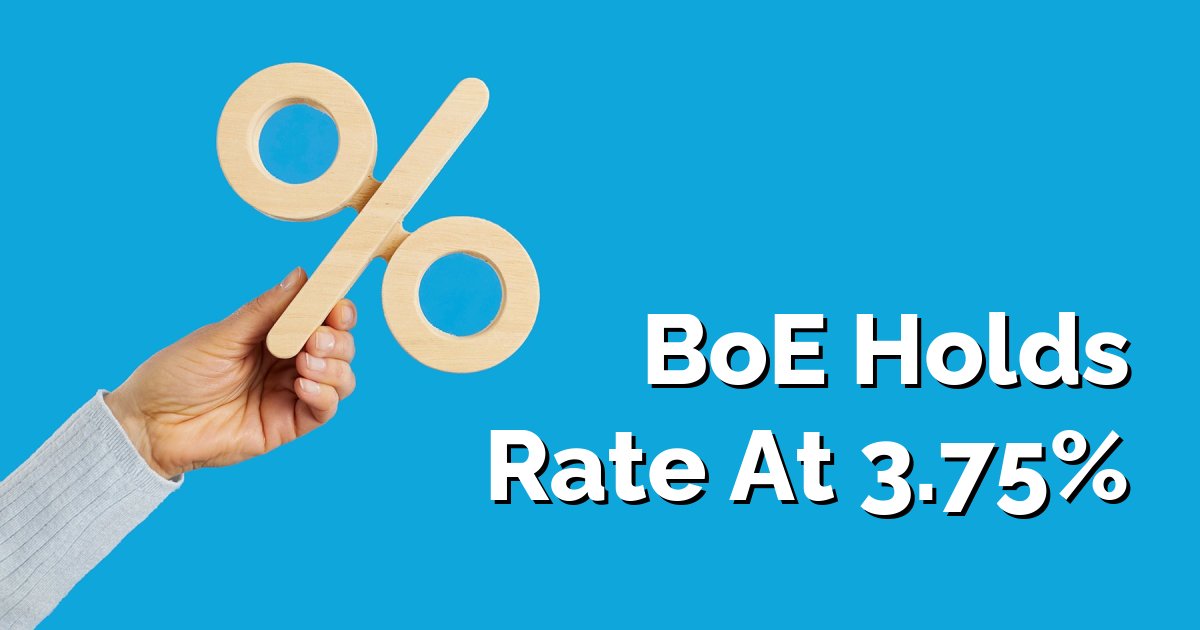
The Bank of England has decided to leave its main Bank Rate unchanged at 3.75%, marking the first time it has stayed at this level since it was cut to that point in December 2025. This decision keeps the base rate at its lowest level since February 2023, a notable milestone as the Bank continues to balance inflation and economic activity.
What the Monetary Policy Committee Decided
At its meeting ending on 4 February 2026, the Bank’s Monetary Policy Committee (MPC) voted to maintain the Bank Rate at 3.75%. The decision was taken by a narrow majority (5-4), with the committee split between those wishing to hold the rate and a minority who favoured a further cut.
This outcome was widely anticipated by economists and markets. In the run-up to the announcement, nearly all economists surveyed expected the MPC to keep rates unchanged, following its December cut from 4% to 3.75% in response to weakening economic indicators.
Why the Bank Has Held the Rate
As the UK’s central bank, the Bank of England operates independently of the government and sets interest rates with a clear goal: to keep consumer price inflation around its 2% target over the medium term. The Monetary Policy Committee meets regularly to assess the latest data on inflation, growth and employment before setting the Bank Rate.
In the latest decision, the Bank highlighted that although inflation has been on a downward trend over recent years, it remains above the 2% target. Most recent figures showed inflation lingering around 3.4% in December 2025, a reminder that price pressures have not yet fully eased.
Against this backdrop, the MPC judged it prudent to pause and gather more evidence on how economic conditions, particularly wage growth and price dynamics, are evolving before making another change to rates.
As the Bank’s Monetary Policy Report explains, while inflation and wage pressures have generally eased, they are still not clearly aligned with the medium-term target. This means policymakers may be cautious and ensure that inflation continues its gradual return towards 2% before cutting rates further.
What This Means for Borrowing and Saving
The Bank Rate plays a crucial role across the UK economy. It influences the cost of borrowing for households and businesses, shaping interest rates on mortgages, loans and savings accounts.
When the Bank cuts the base rate, borrowing tends to become cheaper, a positive for mortgage holders and businesses looking to invest. Conversely, savers often earn less interest on deposits when rates are lower.
Although the rate has remained at 3.75% this month, the MPC’s cautious outlook suggests that future rate reductions may come later in 2026, should the data show inflation is sustainably moving towards the 2% target.
Sources: https://www.bankofengland.co.uk/monetary-policy/the-interest-rate-bank-rate, https://www.reuters.com/world/uk/bank-england-holds-rates-after-narrow-5-4-vote-signals-reduction-ahead-2026-02-05/